
Not sure these techniques are enough on their own? Our Child Counseling can help you get further, faster.
Table of Contents
- Understanding Anxiety in Children
- How to Talk to Your Child About Anxiety
- Identifying Anxiety Triggers and Patterns
- Coping Skills for Anxious Child: Practical Techniques
- Mindfulness for Kids Anxiety: Building Resilience
- Parenting an Anxious Child: Self-Regulation and Support
- Child Anxiety Treatment: When to Seek Professional Help
- How to Help Child With Anxiety: Common Mistakes to Avoid
Last Updated: July 17, 2026
Understanding Anxiety in Children
Anxiety in children is a normal emotional response to perceived threats, but when excessive and interfering with daily functioning, it requires parental attention. Childhood anxiety isn't a character flaw, it's a treatable condition that responds well to validation, coping skills, and professional guidance when needed.
Children experience anxiety differently than adults. Their developing nervous systems lack the emotional vocabulary to contextualize fears. The key difference between normal worry and an anxiety disorder is intensity, duration, and impact. A child who worries occasionally about school is managing normal stress. A child whose anxiety prevents school attendance, sleep, or participation in activities needs intervention.
Signs and Symptoms of Childhood Anxiety
Anxiety shows up across three channels: behavioral, physical, and emotional.
Behavioral signs include avoidance (refusing school, avoiding social situations), perfectionism that interferes with task completion, reassurance-seeking, and restlessness. Some anxious children become irritable rather than visibly worried.
Physical symptoms include stomachaches without medical cause, headaches, muscle tension, sleep difficulty, and appetite changes. These are real sensations created by the body's stress response system.
Emotional signs include excessive worry across situations, difficulty controlling worry, panic responses disproportionate to triggers, and emotional overwhelm.
Common Types of Anxiety in Kids
Generalized anxiety disorder involves persistent worry across multiple areas. Separation anxiety focuses on fear of being away from a parent. Social anxiety centers on fear of judgment in social settings. Specific phobias attach to particular objects or situations. Panic disorder involves sudden, intense fear episodes with physical symptoms like rapid heartbeat or difficulty breathing.
How to Talk to Your Child About Anxiety
Start by naming what you've observed without judgment: "I've noticed you feel worried about going to school. That seems really hard." Ask open-ended questions: "What's the scariest part?" or "When does the worry feel biggest?"
Avoid common missteps: Don't say "You have nothing to worry about" (it invalidates). Don't say "Just calm down" (it's not a choice). Don't avoid talking about anxiety hoping it disappears.
Validating and Empathizing With Big Emotions
Validation means acknowledging that your child's feelings are real and understandable, even if the fear isn't logically justified.
Validation statements that work:
- "I can see this feels really scary to you right now."
- "Your feelings make sense. Let's figure out what to do about them together."
- "It's okay to feel nervous. Lots of people feel nervous about new situations."
- "You're safe right now, and I'm here with you."
Empathy goes deeper, step into your child's emotional world. Use body language: get to eye level, maintain calm facial expressions, speak softly. Your calm nervous system helps regulate theirs. Research shows children whose feelings are consistently validated develop better ability to manage those feelings over time.
Identifying Anxiety Triggers and Patterns
Keep a simple log for a week or two. When your child shows anxiety signs, note: What time of day? What happened beforehand? What was your child thinking about? What physical sensations appeared first?
Common triggers include transitions (schedule changes, moving to a new class), separation from parents, social evaluation, uncertainty, physical sensations (hunger, feeling sick), and situations tied to past negative experiences. Digital anxiety, social media comparison, cyberbullying, creates modern triggers.
| Trigger Category | Examples | Response Strategy |
|---|---|---|
| Separation | Going to school, parent leaving | Predictable routine, reassurance object, gradual exposure |
| Social | New people, performance, evaluation | Social stories, role-play, peer support |
| Transitions | Schedule changes, moving classrooms | Advance warning, visual schedules, practice |
| Uncertainty | Doctor visits, new situations | Information, control through choices, preparation |
| Physical sensations | Hunger, illness, overstimulation | Awareness practice, self-regulation techniques |
| Digital | Social media, online interaction | Screen limits, conversations about comparison |
Coping Skills for Anxious Child: Practical Techniques
Coping skills are tools your child can use independently to manage anxiety. Teach them during calm moments, not during episodes.
Deep Breathing and Relaxation Exercises
Deep breathing activates the parasympathetic nervous system, the body's natural calming system. The 4-7-8 technique works well: breathe in for 4, hold for 7, exhale for 8. The longer exhale signals safety to the nervous system. Box breathing (in for 4, hold for 4, out for 4, hold for 4) is easier for younger children.
Make breathing playful. Blow bubbles matching the breathing or breathe in like smelling flowers, out like blowing out birthday candles.
Progressive muscle relaxation teaches your child to notice and release physical tension. Have them tense a muscle group for 5 seconds, then release and notice the difference. Go through the body: hands, arms, shoulders, face, belly, legs.
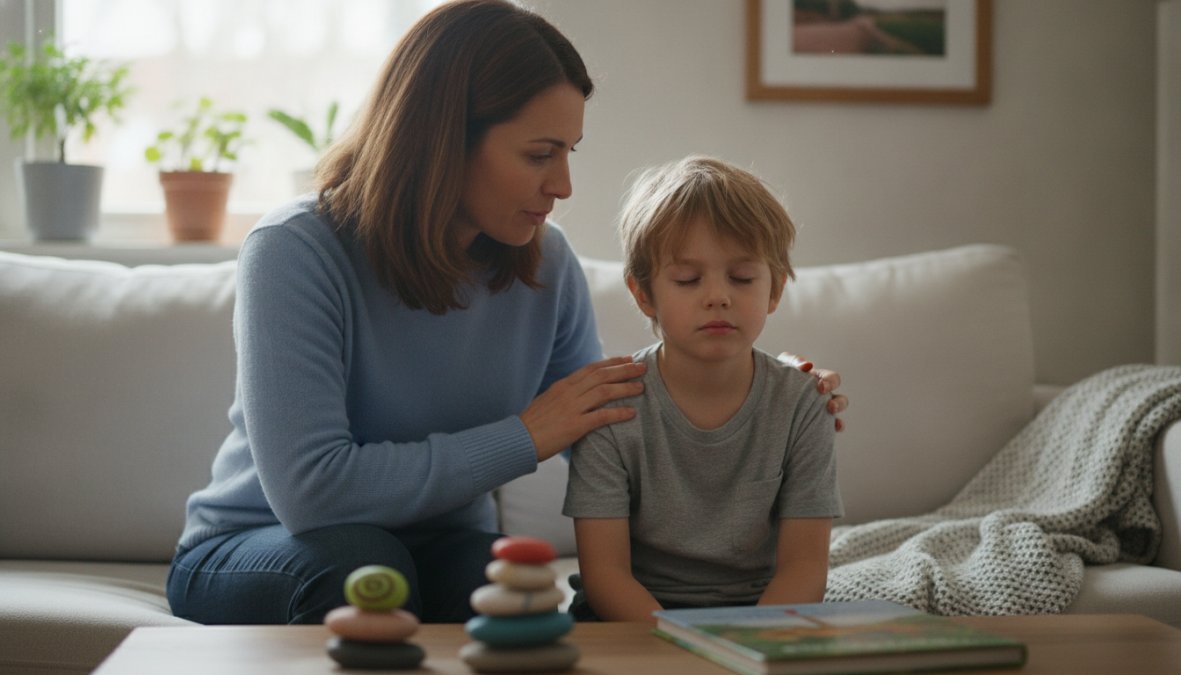
Grounding Techniques: The 5-4-3-2-1 Method
Grounding techniques anchor your child in the present moment, interrupting the anxiety cycle of worry about future "what-ifs."
The 5-4-3-2-1 method: Name 5 things you can see, 4 things you can physically feel, 3 things you can hear, 2 things you can smell, 1 thing you can taste. This pulls attention away from anxious thoughts into sensory experience. Practice during calm moments so your child knows it well.
Challenging Unhelpful Thoughts
Help your child examine anxious thoughts more carefully rather than arguing or dismissing them. Ask questions: "What's the evidence for that thought? What's the evidence against it? What would you tell a friend who had that thought?"
With younger children, draw a thought cloud with the worried thought inside, then ask "Is that thought helpful or unhelpful?" and "What's a more helpful thought?"
Common unhelpful thoughts and more balanced alternatives:
- "Everyone will laugh at me" → "Some people might think it's funny, and some won't. Either way, I can handle it."
- "I'll mess up" → "I might make a mistake, and that's normal. I can try again."
- "Something bad will happen" → "Bad things sometimes happen, but I'm safe right now."
- "I can't do this" → "This is hard, and I can do hard things."
Mindfulness for Kids Anxiety: Building Resilience
Mindfulness, paying attention to the present moment without judgment, builds the mental muscle of noticing thoughts and feelings without being controlled by them. For anxious children, this anchors them in "right now," where things are usually fine.
Start with short practices: 2-3 minutes for younger children, 5-10 minutes for older kids. Consistency matters more than duration.
Simple mindfulness practices include body scans, mindful eating, listening meditation, breathing awareness, and mindful movement. The key instruction: "Your mind will wander. That's normal. When you notice it wandering, just gently bring it back."
Research shows children who practice mindfulness regularly show measurable decreases in anxiety symptoms and improved emotional regulation.
Parenting an Anxious Child: Self-Regulation and Support
Your own nervous system is your most powerful tool. Children's brains borrow your calm until they can build their own.
Managing Your Own Stress and Modeling Calm
When your child is anxious, you might feel anxiety too. But if your child sees you panicked or frustrated, it confirms the situation is genuinely dangerous or unmanageable.
When you feel your own anxiety rising, pause. Take three deep breaths. Remind yourself: "My child is safe right now. This is anxiety, not danger. I can help them through this."
Model the coping skills you're teaching. When you feel stressed, do your own deep breathing where your child can see it. Name it: "I'm feeling frustrated, so I'm going to take some deep breaths to calm down."
Avoid these patterns: Don't accommodate every anxiety-driven avoidance. Don't overprotect to prevent anxiety. Don't express your own worry about their anxiety. Don't punish anxiety.
Building Routines and Predictability
Anxious children thrive with structure. Predictability reduces mental energy spent on uncertainty.
Create consistent daily routines: same wake time, bedtime, after-school routine. Use visual schedules for younger children. Bedtime routines are especially important since anxiety often peaks at night. A consistent 30-minute wind-down (no screens, calm activities, predictable sequence) helps.
Child Anxiety Treatment: When to Seek Professional Help
Some anxiety can be managed with parental support and home strategies. Some requires professional intervention.
Red Flags and Next Steps
Consider professional support if anxiety is interfering with school attendance, learning, or grades; preventing participation in previously enjoyed activities; causing panic attacks; significantly affecting sleep; lasting more than a few months without improvement; or affecting the whole family's functioning.
Start with your child's pediatrician to rule out medical causes and get referrals. The next step is usually a child psychologist or therapist specializing in anxiety.
What to Expect From a Child Psychologist
A good first session involves assessment: when anxiety started, what triggers it, how it's affecting your child's life, and your child's strengths. The therapist will explain their approach and what to expect.
Evidence-based treatments include cognitive behavioral therapy (CBT), exposure therapy (gradually facing feared situations), and parent coaching. Treatment typically involves weekly sessions for 8-16 weeks. Progress isn't always linear, some weeks feel better, then anxiety spikes again. This is normal.
How to Help Child With Anxiety: Common Mistakes to Avoid
Reassurance-seeking loops: Your child asks "Will I be okay?" You reassure them. Five minutes later, same question. Reassurance feels good temporarily but doesn't build confidence. Instead, acknowledge the worry and redirect to coping skills.
Avoidance accommodation: If your child's anxiety says "I can't go to school" and you let them stay home, their anxiety decreases immediately. But you've taught their brain that avoidance works, making anxiety worse long-term.
Overprotection: Protecting your child from every stressor prevents them from developing confidence they can handle challenges.
Expressing your own anxiety about their anxiety: Saying "I'm so worried about how anxious you are" adds shame. Your child needs you to believe they can manage it.
Dismissing the feelings: "You have nothing to worry about" doesn't work because it invalidates their experience.
Skipping the validation step: Moving straight to problem-solving without acknowledging the feeling makes your child feel unheard.
Inconsistent follow-through: If you say your child will do something despite anxiety but then let them skip it when anxious, you've taught them anxiety is a valid reason to avoid.
Frequently Asked Questions
What are the main signs of anxiety in a child?
Anxiety in children manifests through both behavioral and physical symptoms. Watch for excessive worries about everyday situations, avoidance of school or social activities, physical complaints like stomachaches or headaches, sleep disturbances, irritability, and restlessness. Some children with separation anxiety may cling to parents or refuse to attend school. Others may experience panic attacks with rapid heartbeat and difficulty breathing. Each child displays anxiety differently, so understanding your child's unique patterns is essential for providing effective support.
How can I help my child with anxiety using coping skills for anxious child at home?
Teach your child practical coping strategies like deep breathing exercises, progressive muscle relaxation, and grounding techniques such as the 5-4-3-2-1 method. Practice these skills during calm moments so your child can access them during anxious episodes. Create a predictable daily routine to reduce uncertainty. Use validation and empathy when your child expresses worries. Limit exposure to anxiety-triggering situations gradually rather than avoiding them entirely. Consistency and patience are key—coping skills take time to develop and master.
When should I seek professional support for my child's anxiety?
Consider consulting a pediatrician or child psychologist if anxiety significantly interferes with school attendance, friendships, sleep, or family functioning. Professional support is warranted when anxiety persists for more than a few weeks, escalates despite your home strategies, or includes panic attacks or phobias. A mental health professional can assess whether your child has generalized anxiety disorder, social anxiety, or another condition requiring cognitive behavioral therapy or other evidence-based treatment. Early intervention typically leads to better outcomes.
How does parenting an anxious child affect my own mental health, and what can I do?
Parenting an anxious child can increase your stress levels, potentially amplifying your child's anxiety through emotional contagion. Model healthy emotional regulation by managing your own stress visibly—practice deep breathing, maintain routines, and seek support when needed. Avoid reassurance-seeking behaviors that reinforce anxiety. Set boundaries around worry conversations. Consider your own therapy or counseling if parental stress becomes overwhelming. Your calm, regulated presence is one of the most powerful tools for helping your child develop resilience and manage anxiety effectively.